Laser Safety Signs & IPL Safety Signs in Australia
A summary of what the regulations and standards require
Summary
Legal requirements of laser and IPL safety signs depends on the state or territory the business operates in. This article summarises the legislation that applies in each Australian jurisdiction, and the relevant Australian Standards.
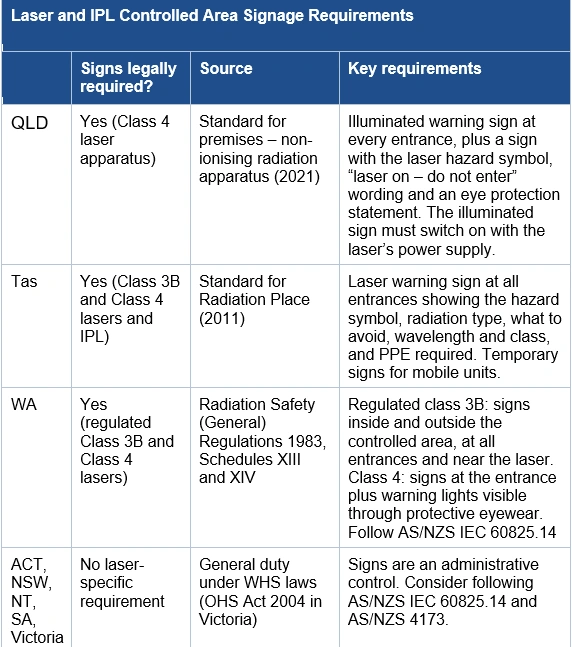
Queensland, Western Australia and Tasmania have legislation requiring laser warning signs, and in Tasmania this extends to IPL. Queensland also requires an illuminated warning sign at the entrance to a laser procedure room. The ACT, New South Wales, the Northern Territory, South Australia and Victoria have no laser-specific signage requirement, but businesses still need to manage laser and IPL risks under work health and safety law. Signs are an important administrative control and businesses may consider following AS/NZS IEC 60825.14 and AS/NZS 4173 to fulfill WHS obligations. These are outlined below.
Queensland
In Queensland, premises where ‘laser apparatus’ are used must meet the Standard for premises – non-ionising radiation apparatus (2021). The Standard requires an illuminated warning sign at every entrance to the laser procedure room. Each entrance must also display a sign showing the laser hazard symbol and words to the effect of “Warning – laser on – do not enter when light is illuminated” and “Eye protection must be worn”.
Laser Safety Compliance Australia has confirmed with Queensland Health that an illuminated warning sign connected to the same switched power supply as the laser, so that it lights whenever power is supplied to the laser, meets the illumination requirement. A manually switched sign does not meet the requirement. It relies on the operator remembering to turn it on and off, and so is not safe by design.
Tasmania
Tasmania is the only jurisdiction where signage requirements extend to IPL. Under the Standard for Radiation Place (2011), all entrances to rooms or areas where a laser or IPL is usually or primarily used must display a laser warning sign. The sign must show the laser hazard symbol and an explanatory label stating:
• the type of radiation, for example visible laser radiation
• what to avoid, for example eye or skin exposure to direct or scattered radiation
• the type of laser, including its wavelength and class
• the personal protective equipment that must be worn.
Mobile laser or IPL equipment requires temporary signs at all entrances to the treatment room or area. No sign is required where equipment is only stored and not used, but the storage place must be secure against theft and unauthorised use.
Western Australia
In Western Australia, regulations 54 and 55 of the Radiation Safety (General) Regulations 1983 require the registrant of premises where regulated Class 3B or Class 4 lasers are used to comply with Schedule XIII and Schedule XIV respectively.
For regulated Class 3B lasers, Schedule XIII requires area warning signs to be displayed:
• in conspicuous locations inside and outside the controlled area
• at all entrances giving access to the controlled area
• in a prominent position near the laser.
For Class 4 lasers, Schedule XIV requires area warning signs at the entrance to the controlled area, and an alarm system of lights, visible through protective eyewear, to warn when the laser is in use.
Signs must comply with the laser safety standard named in AS/NZS 2211.1:2004. This standard has since been superseded by AS/NZS IEC 60825.1 and AS/NZS IEC 60825.14, but the Regulations have not been updated to reflect the current standards. It may be a reasonable approach to follow the requirements of 60825.14; businesses should confirm with the Radiological Council when they need clarification.
ACT, New South Wales, Northern Territory, South Australia and Victoria
The ACT, New South Wales, the Northern Territory and South Australia have adopted the model work health and safety (WHS) laws. Regulation 223 of the WHS Regulations, deals with lasers, but does not mention signage. In Victoria, the Occupational Health and Safety Act 2004 also contains no laser related signage requirements.
The Model WHS laws and the OHS Acct (Vic) require businesses to provide a safe work environment and signs are an important administrative control in achieving this obligation. Workplaces in these jurisdictions may consider following the signage requirements as outlined in the Australian Standards outlined below.
AS/NZS IEC 60825.14
AS/NZS IEC 60825.14 is the Australian user’s guide to laser safety. It recommends:
• laser warning signs at the entrance to laser controlled areas
• signs at the entrance instructing the use of personal protective equipment, where appropriate
• illuminated warning signs that clearly show when a laser is in use, when an interlock is active (where applicable), and when its safe to enter
• placing signs at eye height, preferably beside the door rather than above it.
AS/NZS IEC 60825.14 applies to lasers only. For IPL, refer to AS/NZS 4173.
AS/NZS 4173 Safe use of lasers and intense light sources in health care
AS/NZS 4173 applies to lasers and IPL devices used in health care, including cosmetic settings. It requires area warning signs for Class 3B lasers, Class 4 lasers and IPL devices in risk Category 3. AS/NZS 4173 also recommends signs for Class 1C lasers, and Class 2M lasers where collimated beams are used.
Under AS/NZS 4173, a sign at the entrance to a laser controlled area should include:
• the hazard symbol
• the wavelength of the laser
• the laser classification
• a statement that protective eyewear is required, where applicable
• whether the laser radiation is visible or invisible.
Author: Oliver Ried B.Vis Sci, M.Optom, Grad Cert OHS, Grad Cert Safety & Quality in Health Service Delivery.
Conflict of interest disclosure: Laser Safety Compliance Australia shares ownership with Laser and IPL Safety Supplies.
Last updated: November 2026
References
Queensland Government (1999). Radiation Safety Act.
Queensland Government (2021). Radiation Safety Regulation.
Queensland Government (2021). Standard for premises—non-ionising radiation apparatus.
Radiation Protection Unit Tasmania (2011). Certificate of Compliance: Standard for Radiation Place For Radiation Apparatus: LASER and Intense Pulsed Light Department Of Health and Human Services Population Health. Hobart, Tas.
Safe Work Australia (2025). Model Work Health and Safety Bill, Parliamentary Counsel’s Committee,.
Standards Australia (2018). AS/NZS 4173:2018: Guide to the safe use of lasers and intense light sources in health care.
Standards Australia (2022). Safety of laser products, Part 14: A user’s guide, Standards Australia.
Victorian Government (2004). Occupational Health and Safety Act
Western Australia Government (1975). Radiation Safety Act
Western Australia Government (1983). Radiation Safety (General) Regulations 1983.